

This summer I hosted a gut health lunch at Polgoon, and sitting round that long table afterwards, one thought kept coming back to me.
Gut health isn’t a supplement, a superfood or a fermented drink you have to force yourself to like. It’s mostly a handful of ordinary habits, repeated often enough that your gut bacteria start to notice.
That’s good news, because it means you don’t need to overhaul anything. You just need to know which habits are doing the real work. After twenty years as a chef and now as a health coach, here are the ones I keep coming back to, starting in the kitchen.
Why gut health matters, and where most of us fall short
Your gut is home to trillions of bacteria. Together they help digest your food, train your immune system and make compounds that affect the rest of your body. What you eat is one of the biggest things shaping which bacteria thrive.
Fibre is their main food, and most of us aren’t eating nearly enough of it. UK adults are advised to eat 30g of fibre a day, but the average is around 16g, and only about 4% of adults meet the recommendation (British Nutrition Foundation).
Key stat: only around 4 in 100 UK adults eat the recommended 30g of fibre a day.
The answer isn’t one magic food, though. It’s range. If you’d like to go deeper on fibre itself, read What is Fibremaxxing?.
Variety beats “clean eating” for your gut
I made a big batch of chaat recently, with crispy roasted chickpeas, spiced potatoes and a proper mint chutney, and got a bit carried away counting what went into it. Chickpeas, potatoes, cumin, chilli, curry leaves, turmeric, red onion, coriander, mint, lime and chaat masala. Eleven plants in one dish, before I’d even reached for the yoghurt.
Different gut bacteria thrive on different types of fibre. A gut that only ever sees the same few plants tends to support a narrower community. One that regularly meets new fibres and plant compounds tends to become broader and more resilient.
The American Gut Project, one of the largest citizen-science studies of the gut ever run, found that people who ate more than 30 different plant types a week had more diverse gut bacteria than people who ate 10 or fewer (McDonald et al., 2018).
Thirty sounds a lot until you realise that herbs, spices, nuts, seeds, beans, wholegrains and fruit all count. A curry with five spices is five plants before you’ve added a single vegetable.
You don’t need to count. I find food tracking a bit joyless, if I’m honest. Instead, ask whether this week’s shop looks different from last week’s. A different bean, a new leafy green, a herb you don’t usually buy. That’s the kind of variety your gut is looking for.
Fermented foods: what’s actually worth it
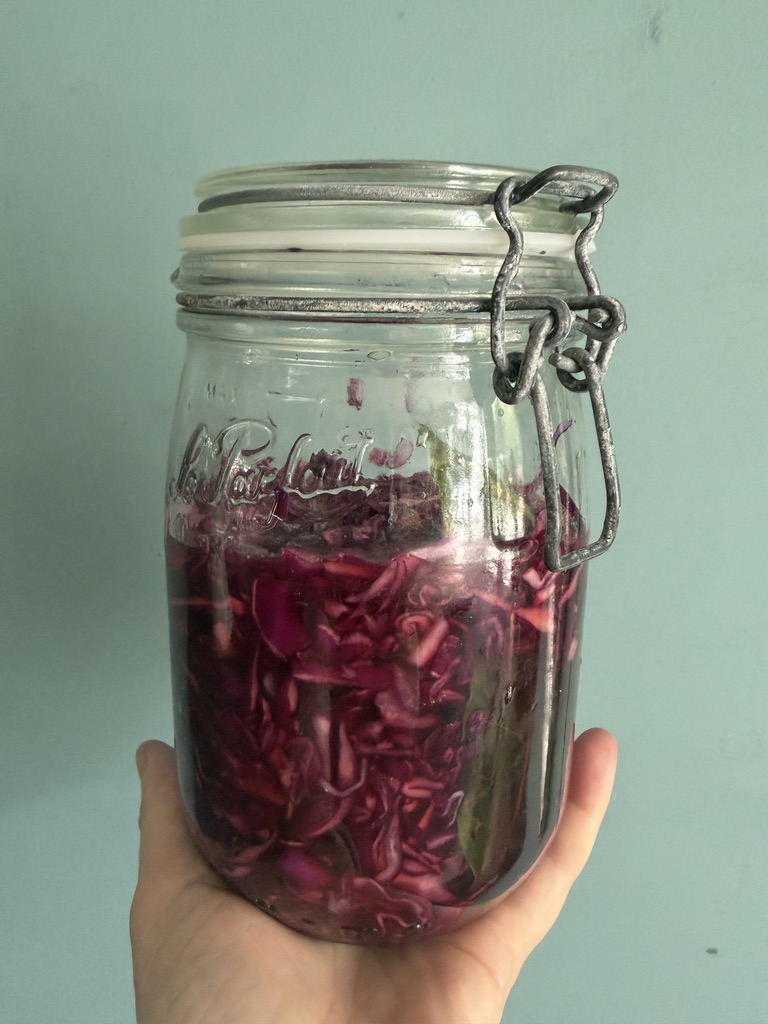
Fermented foods are having a moment, and for once there’s some good research behind the hype.
In a 10-week Stanford study, 36 healthy adults ate either a high-fibre diet or one rich in fermented foods such as yoghurt, kefir, kimchi and fermented vegetables. The fermented-food group’s gut bacteria became steadily more diverse, and markers of inflammation in their blood went down. The high-fibre group’s diversity stayed about the same over the 10 weeks (Wastyk et al., 2021).
That doesn’t mean fibre doesn’t matter. It’s still what feeds your gut bacteria day to day. But it suggests the two work well together. A spoonful of live yoghurt or kefir at breakfast, or a forkful of sauerkraut or kimchi with lunch, is an easy place to start. Look for “live” or “unpasteurised” on the label, because heat-treated versions won’t have the same live cultures.
Why the same meal bloats you some days and not others
For years I assumed bloating was purely about what you eat. Sometimes it is. But two things changed how I think about it, and neither involved cutting anything out.
The first is spice. Ginger, turmeric and cumin are the base of almost every dhal and curry I make. In one small study, ginger helped the stomach empty faster, though it didn’t change how bloated or full people felt (Hu et al., 2011). The evidence is modest, but ginger has been used this way in kitchens for centuries, and I keep reaching for it.
The second is pace, and this one surprised me more. Eating quickly means swallowing more air and sending barely chewed food into a stomach that then has to work harder. A rushed lunch at your desk and the same meal eaten slowly, sitting down, can feel very different an hour later.
You might find it useful to notice which meals sit easily and which don’t, and whether pace has as much to do with it as the food itself.
One important note: occasional bloating is very common, but bloating that won’t go away, or that comes with changes in your bowel habits, weight loss or blood in your poo, is worth checking with your GP (NHS).
Make it a habit, not a project
Understanding all this and actually living it are two different things. The cook in me and the coach in me agree on this one: the second only happens through repetition.
The same handful of meals, made often enough that they stop being “a recipe” and start being just what you eat. A pot of turmeric lentil and spinach dhal. A tray of roasted chickpeas. A bowl of yoghurt with seeds and fruit. None of it is complicated, but over the weeks it adds up.
I often think of these habits as deposits in a Health Pension. Small, steady choices don’t look like much on the day, but they compound over the years.
Bringing it together
Gut health isn’t about perfection or a fridge full of expensive products. It’s about range, a little fermentation and slowing down.
If you take three things from this guide, let them be these:
- Aim for variety across the week. Herbs, spices, nuts, seeds and beans all count.
- Add a little live fermented food, like yoghurt, kefir or sauerkraut, most days.
- Slow down at mealtimes, and let ginger and spices do some of the work.
Wondering how quickly you’ll notice a difference? Read How Fast Can You Really Improve Your Gut Health?. Fibre is good for your blood sugar too, so you might also like How to Steady Your Blood Sugar After 40. For the bigger picture, see my guides to Nutrition for Longevity and Healthy Ageing After 40.
Enjoyed this? There’s more every Friday.
Sign up for my weekly newsletter for food-first ideas and seasonal recipes from my kitchen in Cornwall. Practical, evidence-based, and no extremes.
Sources & Further Reading
British Nutrition Foundation. (2026). Fibre. British Nutrition Foundation. https://www.nutrition.org.uk/nutritional-information/fibre/
Hu, M.L. et al. (2011). Effect of ginger on gastric motility and symptoms of functional dyspepsia. World Journal of Gastroenterology, 17(1), 105–110. https://pubmed.ncbi.nlm.nih.gov/21218090/
McDonald, D. et al. (2018). American Gut: an open platform for citizen science microbiome research. mSystems, 3(3), e00031-18. https://doi.org/10.1128/mSystems.00031-18
NHS. (n.d.). Bloating. NHS website. https://www.nhs.uk/conditions/bloating/
Wastyk, H.C. et al. (2021). Gut-microbiota-targeted diets modulate human immune status. Cell, 184(16), 4137–4153. https://doi.org/10.1016/j.cell.2021.06.019

Leave a Reply