You get home from work. Your coat is half off, your bag is still on your shoulder, and your hand is already in the cupboard.
If that sounds familiar, you’re not short on willpower. Stress and eating are closely linked, and the link gets stronger when sleep is short, the evenings are dark and dinner hasn’t been thought about yet.
I’ve spent over twenty years as a chef and the last few as a health coach. In both jobs I’ve seen the same thing: the moment you reach for the biscuits is rarely where the problem starts. It usually starts hours earlier, with a light lunch, a rough night, or a day spent indoors.
This guide brings together what I’ve been writing about in my newsletter this autumn: how stress, sleep, movement and cooking shape what ends up on your plate. Each section starts in the kitchen, because that’s where the easiest changes are.
How stress and eating are connected

Stress changes appetite in two directions. Short, sharp stress can switch hunger off. Ongoing, everyday stress tends to do the opposite and pull you towards quick, comforting, energy-dense food.
You’re far from alone in this. In a UK survey of 4,619 adults, 46% said they had eaten too much or eaten unhealthily because of stress (Mental Health Foundation, 2018).
Part of the reason is cortisol, the hormone your body releases under pressure. It’s useful in small doses, but when it stays high, many people notice stronger cravings for sweet and starchy foods. Add a long day and an empty fridge, and the cupboard wins.
The good news is that you don’t have to fix the stress to change the eating. You can change what’s waiting for you when you walk through the door.
Why the afternoon slump starts at lunch
The pull towards the biscuit tin at four o’clock often begins at lunchtime, with a meal that was a bit light on protein.
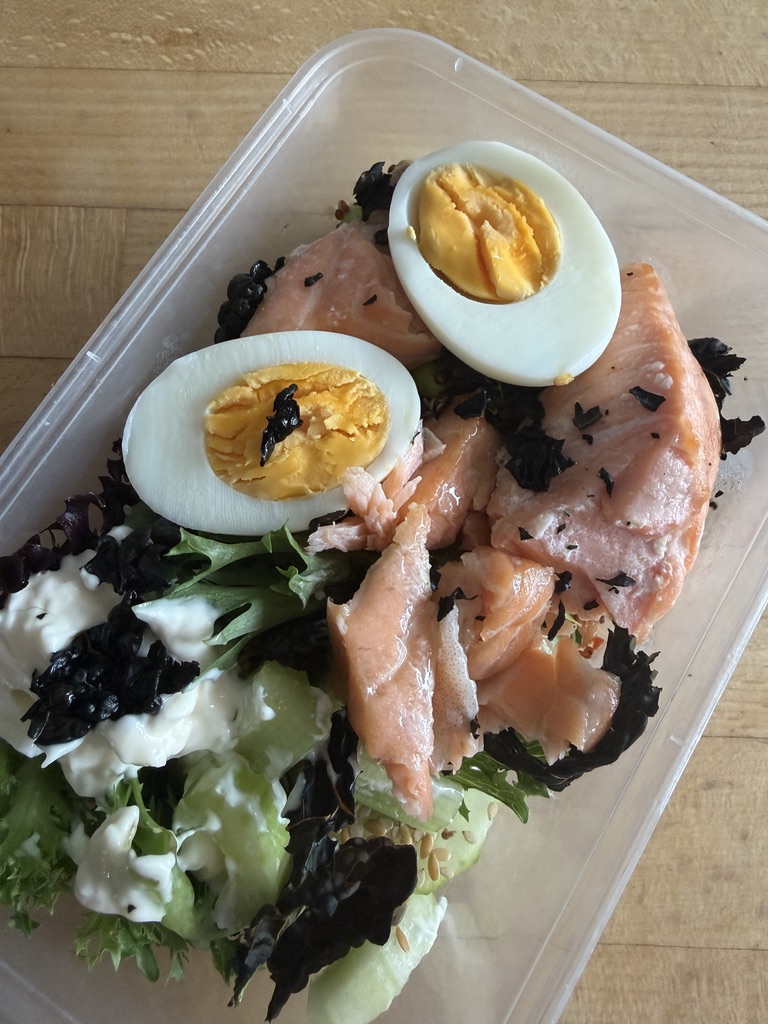
Protein keeps you full for longer than most other foods. A lunch built around eggs, beans, lentils, fish or a good piece of cheese tends to carry you further into the afternoon than a sandwich and a packet of crisps.
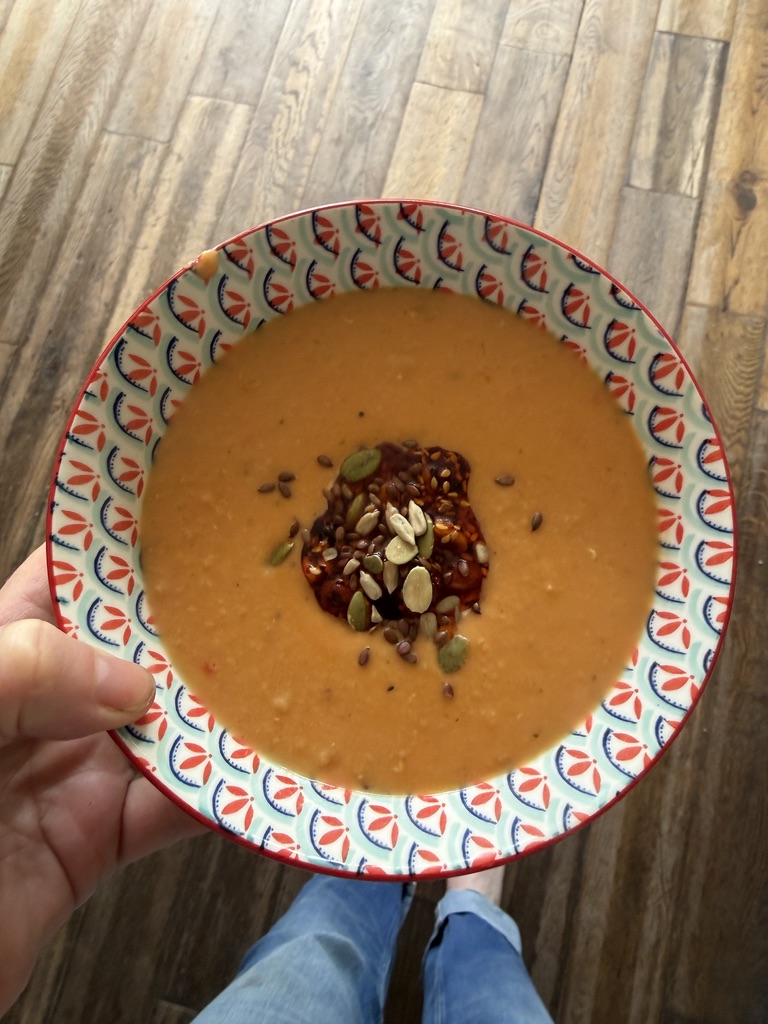
I also keep a jar of mixed seeds on my kitchen shelf. Pumpkin, sunflower and sesame seeds are good sources of magnesium, a mineral your body uses in its stress response. A spoonful on soup, salad or yoghurt is an easy way to add some, plus a bit of crunch.
You might find it useful to look at your lunch before you look at your 4pm snack. That’s often where the change needs to happen.
What a bad night’s sleep does to your appetite
If you’ve ever felt ravenous after a short night, there’s a reason. In a well-known study, two nights of four hours’ sleep raised the hunger hormone ghrelin by 28% and lowered the fullness hormone leptin by 18%. Hunger went up by 24%, especially for sweet and starchy foods (Spiegel et al., 2004).
Key stat: after a short night, people ate around 385 extra calories the next day, but burned no more energy (Al Khatib et al., 2017).
That’s about the same as four and a half slices of bread. Each study was small, but this figure pools the results of 11 of them.
So the morning after a rough night, breakfast matters more than usual. Two of my go-tos are eggs on rye toast, and a pot of tart cherry overnight oats made the night before. Both give you protein and fibre to steady you through the morning, so you’re not fighting your appetite all day.
For more on why sleep matters so much as we get older, read How Sleep Affects Ageing.
A short night also changes how your body handles blood sugar the next day. For simple ways to keep it steady, read How to Steady Your Blood Sugar After 40.
A daylight walk for a flat winter mood
When the clocks go back, mood often dips with the light. A short walk outside in the middle of the day is one of the simplest things you can do about it.
Movement and mood are strongly linked. A large review found that adults who did the equivalent of about 2.5 hours of brisk walking a week had a 25% lower risk of depression than those who did none (Pearce et al., 2022). Even half that amount was linked to a lower risk.
Daylight matters for another reason too. Between October and early March, UK sunlight isn’t strong enough for your skin to make vitamin D. The NHS advises everyone to consider a daily 10 microgram supplement during these months.
Food can help a little. Oily fish, egg yolks and mushrooms that have been exposed to UV light all contain some vitamin D. A pan of mushrooms after a lunchtime walk is one of my favourite winter pairings.
Let the cooking calm you down
We usually talk about what we eat. But how you feel while you’re cooking can matter too.
A systematic review of 11 cooking programmes found links with better mood, confidence and self-esteem (Farmer et al., 2018). The studies were small, so it’s early days. But a separate study of 658 young adults found that people felt more positive and more “flourishing” the day after they’d done something creative, and making up new recipes was one of the most common creative activities (Conner et al., 2018).
None of this surprises a cook. Peeling, stirring and tasting asks for just enough of your attention that there’s no room left for the to-do list.
One approach worth trying: pick one meal a week that you cook for the pleasure of it, not just to get it done. A slow-simmered crumble, a pot of soup, a loaf of bread. Notice how you feel when you sit down to eat it.
Set your evenings up earlier in the day
In my experience working with clients, the people who find their evenings easiest are rarely the ones with the most willpower. They’ve simply set things up earlier in the day.
Three small ways to do that
- A proper lunch, with protein at its centre, so you’re not running on empty by four o’clock.
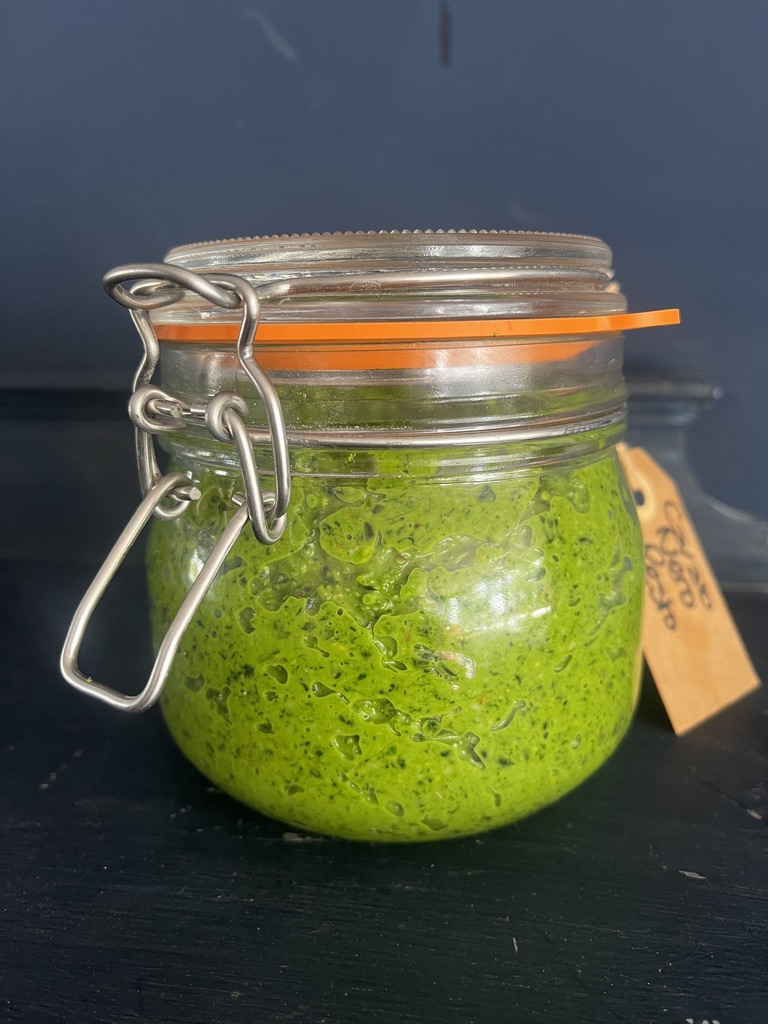
- Something already made. A lentil and mushroom moussaka or a big pot of soup, cooked on a Sunday, means there’s a good meal waiting on the evenings you don’t feel like cooking. When something good is ready, the cupboard loses most of its pull.
- A reason to get outside while it’s still light, even for twenty minutes.
I often think of these as deposits in a Health Pension. None of them looks like much on the day, but small, steady habits add up over the years.
Bringing it together
Stress and eating will always be linked. But most of what happens at six o’clock is decided hours earlier.
If you take three things from this guide, let them be these:
- Look at the few hours before the moment that trips you up. That’s usually where the easiest change is.
- After a short night, give breakfast a bit more care. Protein and fibre will help steady your appetite.
- Get some daylight, and let cooking be a pleasure as well as a job.
For more on building meals that support you as you age, see my guide to Nutrition for Longevity. For the bigger picture, see Healthy Ageing After 40.
Enjoyed this? There’s more every Friday.
Sign up for my weekly newsletter for food-first ideas and seasonal recipes from my kitchen in Cornwall. Practical, evidence-based, and no extremes.
Sources & Further Reading
Al Khatib, H.K., Harding, S.V., Darzi, J. & Pot, G.K. (2017). The effects of partial sleep deprivation on energy balance: a systematic review and meta-analysis. European Journal of Clinical Nutrition, 71, 614–624. https://www.nature.com/articles/ejcn2016201
Conner, T.S., DeYoung, C.G. & Silvia, P.J. (2018). Everyday creative activity as a path to flourishing. The Journal of Positive Psychology, 13(2), 181–189. https://doi.org/10.1080/17439760.2016.1257049
Farmer, N., Touchton-Leonard, K. & Ross, A. (2018). Psychosocial benefits of cooking interventions: a systematic review. Health Education & Behavior, 45(2), 167–180. https://pubmed.ncbi.nlm.nih.gov/29121776/
Mental Health Foundation. (2018). Stress: are we coping? Mental Health Foundation. https://www.mentalhealth.org.uk/explore-mental-health/statistics/stress-statistics
NHS. (n.d.). Vitamin D. NHS website. https://www.nhs.uk/conditions/vitamins-and-minerals/vitamin-d/
Pearce, M. et al. (2022). Association between physical activity and risk of depression: a systematic review and meta-analysis. JAMA Psychiatry, 79(6), 550–559. https://pubmed.ncbi.nlm.nih.gov/35416941/
Spiegel, K., Tasali, E., Penev, P. & Van Cauter, E. (2004). Sleep curtailment in healthy young men is associated with decreased leptin levels, elevated ghrelin levels, and increased hunger and appetite. Annals of Internal Medicine, 141(11), 846–850. https://pubmed.ncbi.nlm.nih.gov/15583226/